

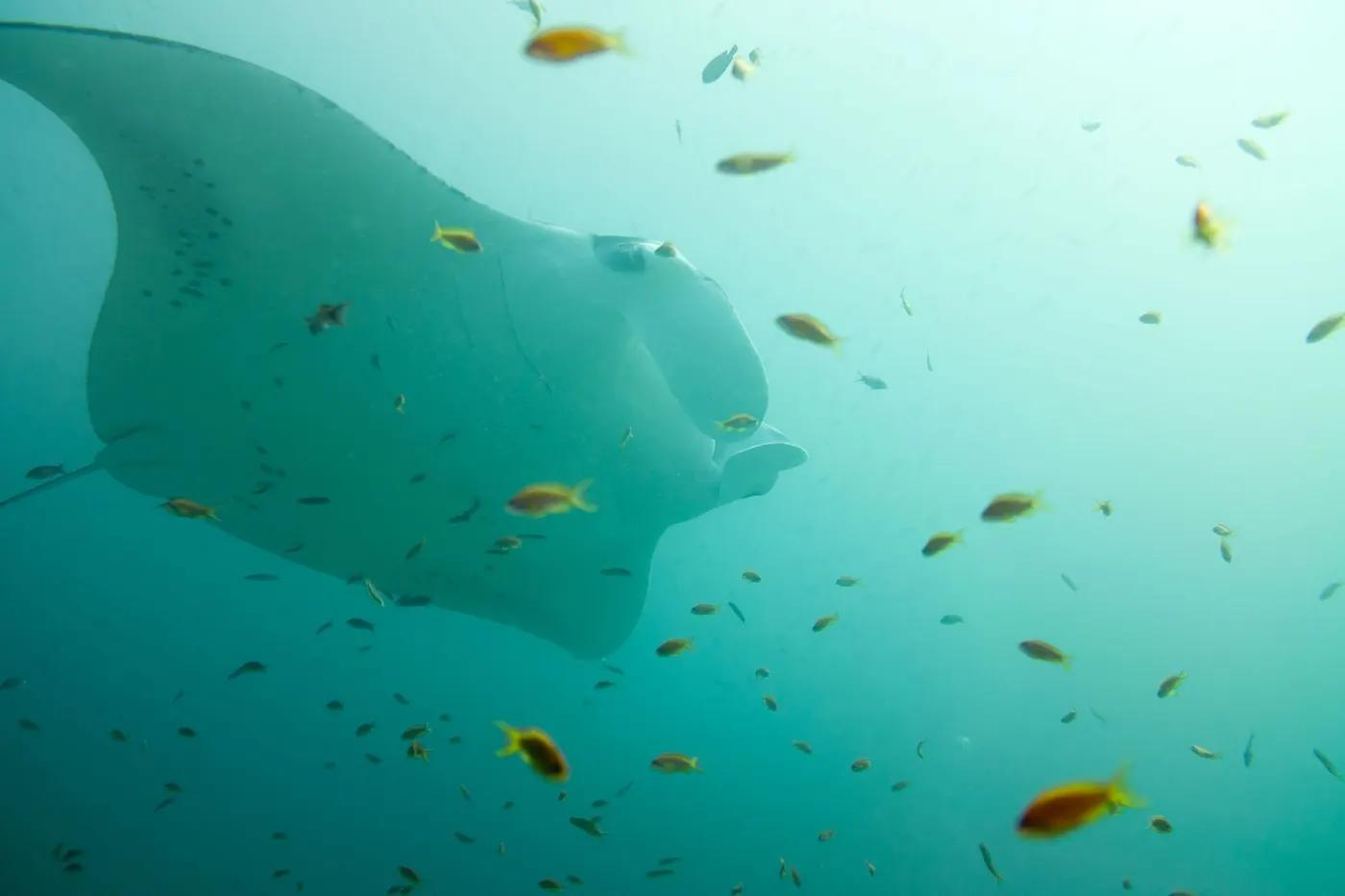
Great Astrolabe Reef Manta Rays
Also known as: Manta Reef, Kadavu mantas
Reef mantas queue at cleaning stations on the world's fourth-largest barrier reef
The encounter
Species / spectacle: Reef manta rays at cleaning stations, plus fusiliers, mackerel, dogtooth tuna, clownfish, hard corals and fans, with occasional pelagics.
How you see it: dive/snorkel
Typical duration: Two-tank morning boat trip; around a 40-min boat run from southern resorts to Manta Reef, with two dives and a surface interval.
When to go
Manta activity concentrates roughly May-November in the dry season, with peak clarity and settled conditions; some sites report year-round mantas.
Strongest through the dry-season window and lower and less predictable in the wet season. Confirm month-by-month detail with the operator (Confirm.).
Best time of day: Morning dives are standard, tied to the boat schedule and tide or current windows.
Dry-season manta aggregations at cleaning stations, with excellent visibility overlapping the peak window.
Sightings are seasonal probabilities, not promises - even in peak season nature does its own thing.
Who it suits
Difficulty (1-5): 3 (moderate)
Physical demand: The reef top near 15m is recreational-friendly, but channel currents can be strong; good buoyancy is needed to hover off cleaning stations without disturbing mantas.
Accessibility & group fit: Suitable for certified recreational divers, with some sites occasionally snorkelable. The remote location suits small groups.
Options for a mixed group: Small resort-based dive groups. Confirm maximum divers per guide with the operator (Confirm.).
Permits & responsible travel
Regulation / permits / fees: Dives run through licensed resort dive centres, with customary village and reef access plus any marine-area fees handled by operators. A manta code of conduct applies, including no touching and keeping distance.
Guide / crew: Resort PADI dive centres such as Mad Fish Dive Centre at Matava guide all dives; local tide knowledge is essential.
Follow the manta code of conduct - do not touch or chase, stay low and to the side of cleaning stations, and avoid close flash. Kadavu is remote and community-managed, so respect qoliqoli reef tenure.
Permits, fees and quotas change - confirm before booking.
Safety & hazards
Strong channel currents, remoteness and boat logistics, plus depth and drift on outer-reef sites.
Weather / conditions: Exposed barrier-reef channels bring current and swell, and wet-season rain reduces visibility. Trips are weather-dependent.
Remote setting with nearest hyperbaric care via Nadi or Suva by air; DAN insurance is essential given evacuation distance.
Getting there & staying
Access logistics: Fly from Nadi or Suva to Kadavu at Vunisea airstrip, then transfer by boat to the resort; Manta Reef is around 40 min by boat from southern resorts.
Accommodation / camping: Dive resorts on Kadavu including Matava and Oneta, mostly eco-resorts with no camping. Book dive packages.
Gear / water / connectivity: Resort dive centres supply gear; mobile and internet coverage on remote Kadavu is limited and patchy.
Facilities: On-site PADI dive centres, boats and briefings at resorts, with limited services in Vunisea.
Crowds / solitude: Uncrowded and pristine, with far fewer divers than Viti Levu and often near-solitude at the sites.
Operators & guiding
Nearby operators / hubs: Matava with Mad Fish Dive Centre, Oneta Resort and Mai Dive/Astrolabe Reef Resort; hub is Vunisea.
Guided trips / outfitters: Resort dive centres on Kadavu run Manta Reef trips; book through the resort.
Operators change - confirm current licensing before you book.
Live conditions & sources
Recent sightings and today's conditions are a runtime layer - check the sources: fiji.travel; matava.com; padi.com; diveplanit.com. Web content, rights held by publishers.
This profile is desk research, compiled from public sources - not a first-hand wildlife report. Coordinates are approximate.